The Culture of Death Spreads
Once again my heart is greatly troubled. In recent weeks it was announced that Nidal Hasan will be executed by a military firing squad for a terrorist attack where several lives were lost.
I am against the death penalty but the morality of the death penalty is not what most troubles my heart this week (If you want to read/view what Catholic teaching says and I believe about the death penalty, please see the second half of Part II of my series, Treating Live with Dignity and Love. Cf. My articles, “Considerations on the Death Penalty”, “A Letter to a Victim’s Family”, and “A Letter to a Killer”).
When I first heard that the execution would happen by a firing squad, I was troubled to think that in our modern society we continue with barbaric actions like a firing squad. Then again, we just had the botched execution of a woman in Tennessee when the drugs used for the attempt to execute her did not work as intended.
What troubles my heart most right now is the announcement this week that the execution of Nidal Hasan would be openly livestreamed. Has society become so depraved that watching an execution becomes a public event in the 21st century? Is this to be entertainment like in the Roman Empire with public executions by animals?
I see this as being about vengeance and a product of the culture of death. There has been a general loss of respect for life. Yes, Nidal Hasan is guilty of terrible crimes, including murder. We have a right to justice. We do not have a right for vengeance. If you support the death penalty, you might want to point to Leviticus 24:20 where it says, “eye for eye.” My response is to point you to Jesus’ words in Matthew 5:38-42.
The spreading culture of death denies the sanctity and dignity of life (see Part I of my series Treating Life with Dignity and Love to see what our Catholic faith says about the dignity of life). When society says abortion is acceptable, the culture of life is wounded while the culture of death spreads. When society erroneously says assisted suicide is acceptable, the culture of life is wounded while the culture of death spreads. Even the execution of a guilty person wounds the culture of life while the culture of death spreads. If you want the violence to stop, please help build a culture of life (please see my article, “Towards a Culture of Life.”).
Only a culture of death would see openly livestreaming an execution as even a possibility. I see no need for livestreaming the execution. It feeds hatred and hate only brings more hate.
One may call for the death penalty for justice. The first murder in the Bible was Cain killing his brother Abel (Genesis 4:1-16). Cain committed a mortal sin in killing his brother. Yet, not only did God not kill Cain for his sin, God put His mark on Cain so that no one would kill Cain. In doing so, God said no to the death penalty. As Pope Saint John Paul II wrote in Evangelium Vitae, “Not even a murderer loses his personal dignity, and God himself pledges to guarantee this” (9). Does a person who thinks the death penalty is a good thing, think they know better than God?
When I heard the announcement that the execution of Nidal Hasan would be livestreamed, I wondered about writing a blog article on this but my initial thoughts were my own. Friday morning, the USCCB released a statement against the livestreaming. When I read the statement, my thoughts went from my own to thoughts that I felt were inspired by God. So, I wrote down what I felt were inspired thoughts. This article shares what I felt as inspired thoughts.
I fear the culture of death is killing the souls of innocent people and our society as it spreads. Yet, we have hope because God is a loving and forgiving God. We cannot fix this on our own. We don’t have to fix it on our own. We need to cooperate with God’s Will and He will fix what we have broken.
What do you think should be done to Nidal Hasan for the terrible crimes he committed?
Do you want to see him dead? If you do, I pray that you let go of the anger in your heart for the anger eats away at your soul. I see this as vengeance and hatred, not justice.
Do you want to see him punished? He does deserve punishment but punishment does not require the death penalty. Remember Jesus’ words, “Be merciful, just as [also] your Father is merciful” (Luke 6:36). Maybe you have never killed a person but none of us (except Jesus and Mary) is without sin. We need God’s mercy. We need His forgiveness. If we want to be forgiven, we must be willing to forgive. This does not mean letting Hasan go without any punishment. It does mean letting go of the anger.
Do you want to see criminals turn their hearts to Christ? Enforcing the death penalty takes away their chance of giving their hearts over to Jesus. This comes not from me alone. In the United States Catholic Catechism for Adults, we read, “When dwelling on legal and moral arguments concerning the death penalty, we should do so not with vengeance and anger in our hearts, but with the compassion and mercy of our Lord in mind. It is also important to remember that penalties imposed on criminals always need to allow for the possibility of the criminal to show regret for the evil committed and to change his or her life for the better” (395, emphasis added).
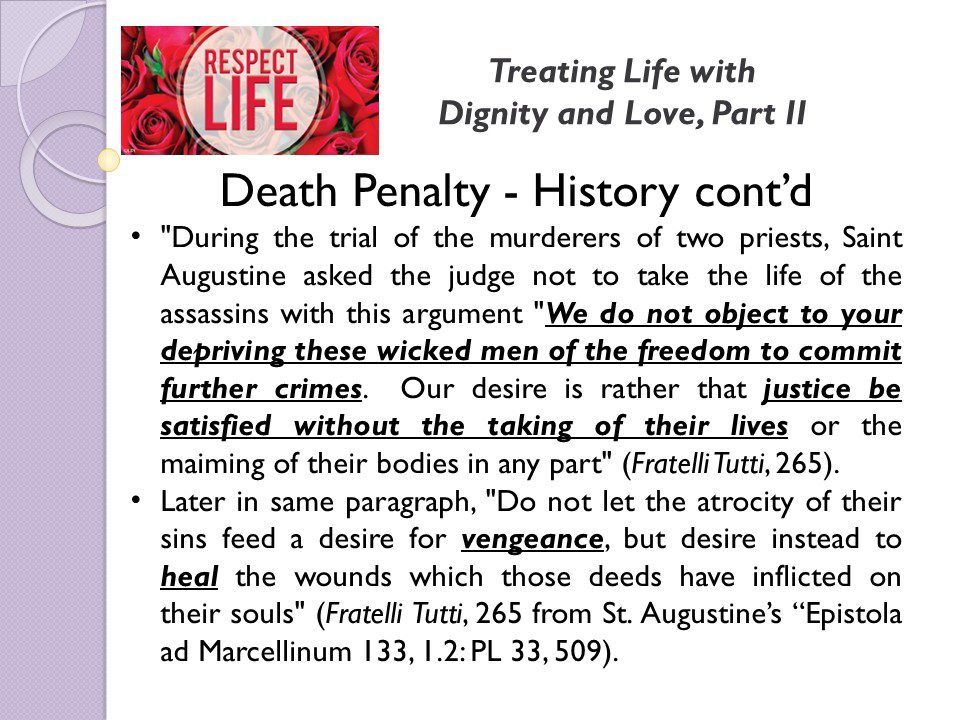
Saying no to the death penalty is not new in our Catholic Church today. God did not execute Cain. Jesus called for peaceful responses. Following Jesus’ teaching, here are some slides from my series, Treating Life with Dignity and Love Part II with quotes from the Church Fathers.
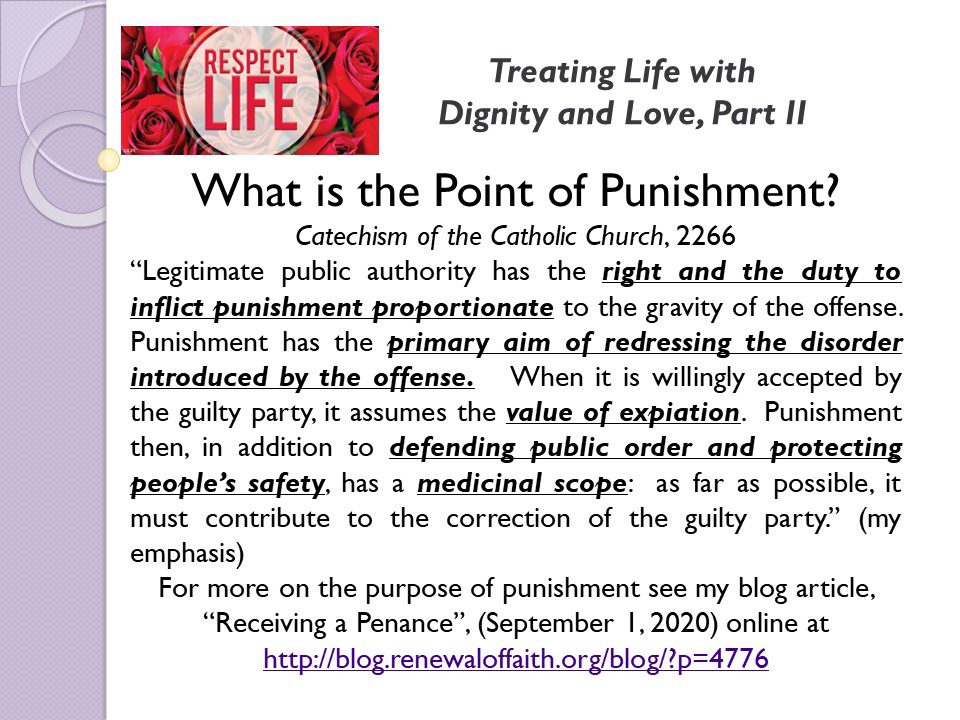
Our Catholic Church does not reject punishment.
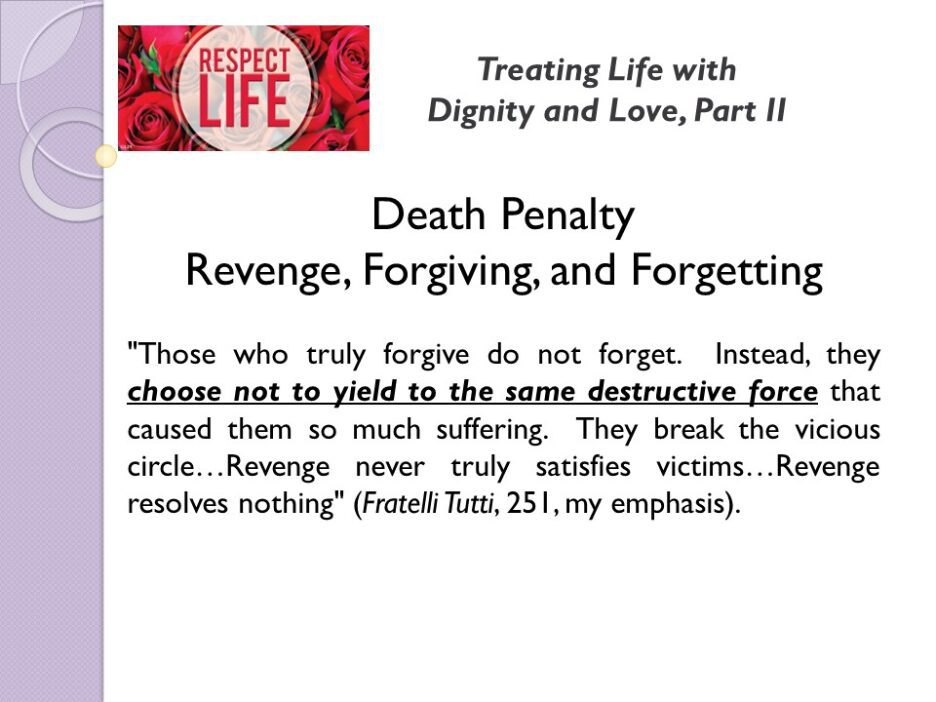
If you think forgiving requires forgetting, Pope Francis taught otherwise.
The words of Jesus found in John 3:16-17 speak to what God wants for sinners, “For God so loved the world that he gave his only Son, so that everyone who believes in him might not perish but might have eternal life. For God did not send his Son into the world to condemn the world, but that the world might be saved through him.”
What do you want for sinners? Do you want them condemned or saved? Don’t forget you are a sinner!
The situation is not hopeless for nothing is impossible for God. We might feel powerless, but we are not powerless against sin and the devil. We have God on our side. Actually, that is not quite right. We should not have a side of our own. We should be on God’s side. Are you?
Perhaps you are troubled by this as I am. I conclude with the words of the Serenity Prayer.
God grant me the serenity
to accept the things I cannot change;
courage to change the things I can;
and wisdom to know the difference.
Living one day at a time;
enjoying one moment at a time;
accepting hardships as the pathway to peace;
taking, as He did, this sinful world
as it is, not as I would have it;
trusting that He will make all things right
if I surrender to His Will;
that I may be reasonably happy in this life
and supremely happy with Him
forever in the next.
Amen.
(Reinhold Neibuhr, written in the 1930’s)
Update – On October 15, 2026, the President’s office announced that the execution would not be livestreamed. I am very grateful for this.
Peace,
Fr. Jeff
Thanks, Fr. Jeff, for your commentary about the Culture of Death. Understanding more about it from your writing is helpful to me. I used to be somewhat confused by this topic when previous Catholic clergy (even Popes) talked or wrote about it.
I also do not want to witness the execution of Nidal Hassan by firing squad or any other method. It seems to me that violence leads to more violence and rarely solves important political problems.
For the good of society generally we all need to manage our anger better. As you say, we have a right to justice but not a right for vengeance. I know that I am a sinner who finds it difficult at times to manage or control my anger in a more constructive way.
I will pray Reinhold Neibuhr’s version of the Serenity Prayer. Thanks for sharing it with us.
Thank you Carol for your comments.
Peace,
Fr. Jeff