
14th Sunday in Ordinary Time, Year A – Homily (2026)
14th Sunday in Ordinary Time, Year A
Zechariah 9:9-10
Psalm 145:1-2, 8-9, 10-11, 13-14 (1)
Romans 8:9, 11-13
Matthew 11:25-30
July 5, 2026
As I have been transitioning from my last parish to here (St. Louis Church), I have been reflecting on what God is asking me to do and who I am as a child of God (see my blog article “Change Leads to Reflection”).
I think these are questions we all need to ask ourselves from time to time. One might begin their reflection by asking if, using Jesus’ words from the gospel, one would name themselves among the “wise and the learned” or as one of the “little ones.”
To do so, we must ask ourselves what Jesus means by these phrases. When Jesus speaks of the “wise and the learned,” He is not telling we should not be educated. God gave us our brains and the gift of reason and He wants us to use them. Here, I love to learn and teach our faith so that we can all grow in our personal relationships with Jesus.
When Jesus speaks of the “wise and the learned,” He is speaking of those who flaunt their knowledge and think they know better than everyone.
On the other hand, when Jesus speaks of the “little ones,” He points us to little children who are always open to learning more and are “meek and humble of heart.” To these our Lord gives us the yoke of our faith not to burden us but as a gift to live knowing Jesus as the way and the truth and the life (John 14:6).
When we are reflecting on our identity as Catholics, we should also ask ourselves if we live “in the flesh” or “in the spirit” for, as Paul writes, “if you live according to the flesh, you will die, but if by the Spirit you put to death the deeds of the body, you will live.”
Which is more important to you, worldly ways or godly ways (see my homily from last week)?
As we think about our individual identity, we should ask ourselves about our Catholic identity and our civic identity. In the Old Testament, the Israelites identified as the people of God and as a nation, both identified by the prophets as “Zion” and “Jerusalem.”
For our Catholic identity, we can think about what it means to be “one, holy, catholic, and apostolic church.”
For our civic identity, we celebrate the 250th anniversary of our nation signing of the Declaration of Independence on July 4, 1776.
There are people who want to completely separate faith from civic life. This is not our Catholic understanding of the way we should live. You can read on the banner out in front of our church, “One Nation Under God celebrating 250 Years of Faith & Freedom.”
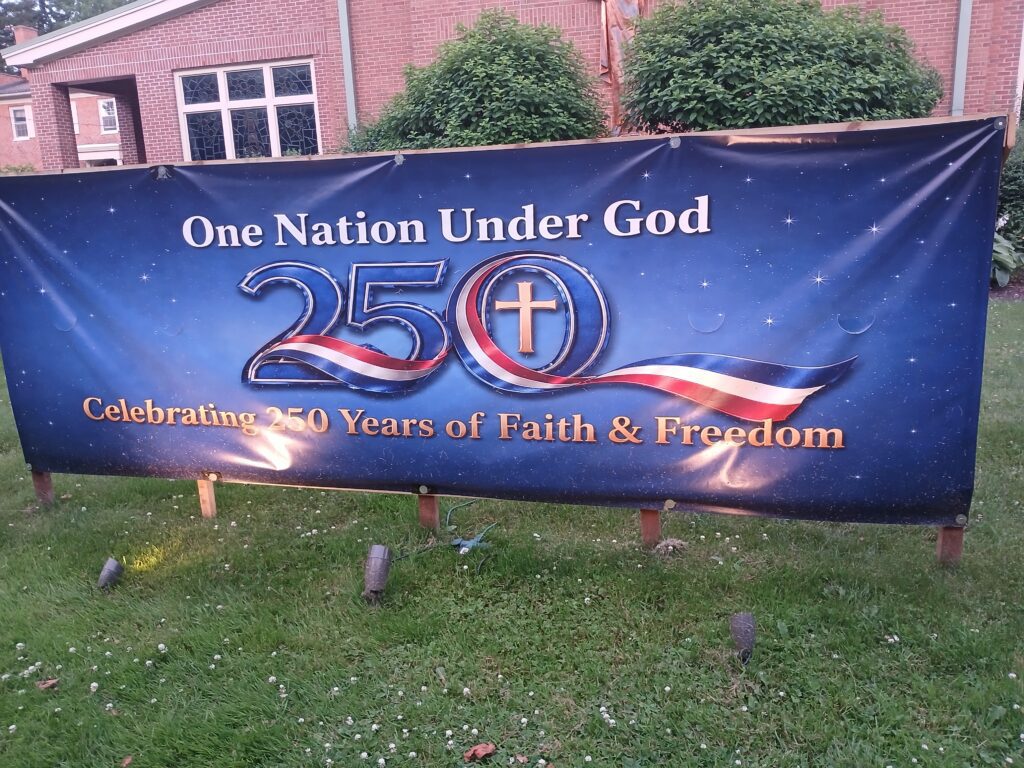
For us, faith and freedom go together.
Our Declaration of Independence explicitly refers to our Creator as the source of our unalienable rights of life, liberty, and the pursuit of happiness. As a nation founded in faith, we can read on our money, “In God We Trust.”
Our Declaration of Independence refers to truth when it says, “We hold these truths to be self-evident…” Truths like “all men are created equal.” This means every single person, regardless of whether they are male or female, a U.S. Citizen, the language they speak, or their place of birth. This is biblical! We read in Revelation 7:9 that God welcomes people from every nation into Heaven. He gives everyone the same unalienable rights we have been given.
One of the three rights explicitly listed in our Declaration of Independence is the right to life. I will save this for the future. For now, just know that I am strongly prolife (see the prolife section on my website).
The second right explicitly listed in our Declaration of Independence is liberty for which we often use the word freedom. People speak of freedom in the sense of people being allowed to do whatever they want, including defining their own truth. God gives us free will.
Those are people who see God’s commandments and teachings as a restriction to our freedom. God does not teach us His Ways to make slaves of us. He gives us commandments and teachings to set us from slavery to sin so that we may live in the freedom of His Love. The Catechism of the Catholic Church calls us to follow our conscience (1782) but we must have a well-formed conscience (Catechism, 1783-1784).
As Catholics we have freedom. The question is what do we do with our freedom. As Pope St. John Paul II once said, “Every generation of Americans needs to know that freedom consists not in doing what we like, but in having the right to do what we ought” (“Homily of his holiness John Paul II” during his Apostolic Journey to America. Oriole Park at Camden Yards, Baltimore. October 8, 1995. 7.)
The third right explicitly listed in our Declaration of Independence is the pursuit of happiness. Do you seek, does our nation seek happiness in worldly ways or in the ways of the Spirit?
Do you live for your own happiness or do you live in solidarity with your neighbor? Do you love your neighbor as God loves you? As we celebrate the 250th anniversary of our nation, we can ask the same questions of our nation and give praise and thanks to God for the good we have done in our love for others.